CORRALEJO · GREAT BEACHES
Fuerteventura


DISCOVER US
The Olive
'A place of history'
The Olive
'A place of history'
La Oliva likely owes its name to the presence of wild olive trees (acebuches) in its territory. This place, situated on a vast plain of fertile land, was an important settlement center for the Majos, an aboriginal people predating the Spanish period, which began with the conquest of Fuerteventura in 1405.

An anonymous manuscript recounts that the town of La Oliva was founded in 1500 by individuals known as the Hernández brothers, residents of the town of Betancuria, who built two small houses in this jurisdiction with the intention of moving to this area during the planting season…
Gradually, new towns are emerging such as: Corralejo, La Oliva, the port of El Tostón (El Cotillo), Vallebrón, La Caldereta, Los Lajares, Villaverde, El Roque, Parque Holandés, Tindaya…
From the establishment of the parish in 1711 and the transfer of the Colonel, La Oliva became the main political and social center of Fuerteventura thanks to the power of the Colonels. The reforms enacted by the Cortes of Cádiz in 1812 allowed it, upon exceeding one thousand inhabitants, to become an independent municipality from Betancuria.

After the disappearance of Los Coroneles at the end of the 19th century, La Oliva lost prominence to Puerto del Rosario. For centuries, its economy depended on cereal farming, livestock, and fishing.
From the 1970s onward, the tourism boom transformed the service sector into the engine of regional development. This growth boosted the population from 2,900 inhabitants in 1975 to nearly 25,000 today.
In the cultural sphere, the arrival of foreign populations has introduced new habits, relegating the traditional way of life to a secondary role.


LANDSCAPES
The municipality of La Oliva is located in the north of the island of Fuerteventura, with an area of 356.13 km² (21.5% of the total island), including the island of Lobos.
Tindaya Mountain is a unique space that contains important archaeological and geological values.
The Corralejo Natural Park is characterized, primarily, by its spectacular dune field.
The Isla de Lobos Natural Park is home to some 130 animal and plant species, in the middle of a landscape scarcely altered by man.
The Malpaís de la Arena Natural Monument is the result of volcanic eruptions from about ten thousand years ago that gave rise to a landscape of great beauty.
The Vallebrón Protected Landscape preserves the structures built by man for the agricultural use of the land in the middle of a fertile valley.
 |  |  |  |
|---|---|---|---|
 1 (5) |  Rombo 03 |  Rombo 01 |  Rombo 02 |
 Rombo 04 |  |  1 (1) |  1 (2) |
 1 (3) |  1 (4) |
Perfect temperature, unforgettable landscapes

La Oliva is characterized by having a warm climate, with a perfect temperature almost all year round that ranges between 20º and 25º and that in winter rarely drop below 15º.
Located in the north of Fuerteventura, it's an ideal spot for family holidays and a great place for surfing, windsurfing, diving, or fishing. Explore the trails that reveal its spectacular volcanic landscapes and the Isla de Lobos and Corralejo Dunes Natural Parks.
PARTIES

Great expressions
of the island's folklore
Great expressions
of the island's folklore
Folklore was always maintained through parties at patron saint festivals, social gatherings, or songs during planting and harvesting times.
The stories and legends are steeped in magic, especially in the Tindaya area. Traditions linked to religion persist, such as the Rancho de Ánimas at Christmas in the village of La Oliva.
 0W5A5176 |  ROMERIA DE MAJANICHO-23 |  GB8A2493 |
|---|---|---|
 GB8A3123 |  Fiestas locales-4 |  Fiestas locales-3 |
 Fiestas Candelaria-36 |  8P7A2322 | 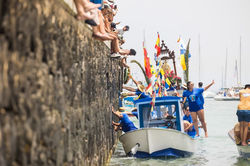 0W5A5708 |
 0W5A5261 |  0W5A5456 |  8P7A1517 |


Carnival
Carnival
The quintessential festival is the vibrant and colorful Carnival of Carnivals in Corralejo, celebrated in March. For a few days, Corralejo becomes a showcase of the imagination and joy of its people.
 1 (12) |  1 (11) |  1 (10) |
|---|---|---|
 1 (9) |  1 (8) |  1 (5) |
 1 (7) |  1 (6) |  1 (2) |
 1 (4) |  1 (3) |  1 (1) |
It is considered one of the most important carnivals in the Canary Islands. Among its events, the Drag Queen Gala stands out as the main attraction of the carnival program, and is the oldest after the Drag Queen Gala of Las Palmas de Gran Canaria.


Patron Saint Festivities
Celebrations that unite faith,
culture and tradition
Patron Saint Festivities
Celebrations that unite faith,
culture and tradition

Our Lady of Candelaria
the olive
Every February, La Oliva celebrates its patron saint festivities in honor of Our Lady of Candelaria, one of the most deeply rooted traditions of the municipality.
The main events take place on February 2nd with the solemn religious service and the procession of the patron saint through the streets of the town, in an atmosphere of great community participation and popular tradition.


